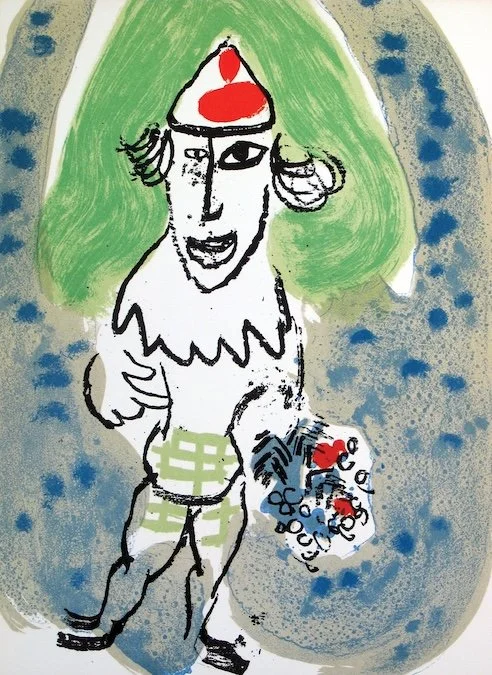
Marc Chagall 1887-1985
Chagall was born in Vitebsk, Russia in 1887. After studying in St Petersburg he went to Paris where he befriended the avant-garde circle of artists. In 1917 he returned to his native Vitebsk where he was made Director and Commissar of Fine Art. However, his fantasy-based work irked the conservative authorities so he left for Moscow to design for the new Jewish Theatre.
Read more
Returning to Paris in 1923 he met the art-dealer Vollard for whom he illustrated Gogol’s Dead Souls and the Fables of La Fontaine. Between 1941-47 he moved between occupied France and the USA, eventually settling near Nice. Chagall was a prolific artist, his work reminiscent of Jewish life, bible stories and of the folklore from his early years in Russia. He died in 1985.
Lithograph, 1975
Suite: Odyssey of Homer
Unsigned
Edition of 250
Paper size: 32.5 × 44cm
£2000 Framed
Marc Chagall’s Odyssey of Homer portfolio is a tribute to Homer’s epic poem and illustrates the main stages of the text. Chagall visited Greece twice, in 1952 and 1954, and it was from these visits that he drew much of his inspiration from the ancient mythological motifs. The lithographs were published and printed by Fernand Mourlot in Paris and some of the images required as many as 20 layers of colour.
Lithograph, 1975
Suite: Odyssey of Homer
Unsigned
Edition of 250
Paper size: 32.5 × 44cm
£2000 Framed
Marc Chagall’s Odyssey of Homer portfolio is a tribute to Homer’s epic poem and illustrates the main stages of the text. Chagall visited Greece twice, in 1952 and 1954, and it was from these visits that he drew much of his inspiration from the ancient mythological motifs. The lithographs were published and printed by Fernand Mourlot in Paris and some of the images required as many as 20 layers of colour.
Lithograph, 1975
Suite: Odyssey of Homer
Unsigned
Edition of 250
Paper size: 32.5 × 44cm
£2000 Framed
Marc Chagall’s Odyssey of Homer portfolio is a tribute to Homer’s epic poem and illustrates the main stages of the text. Chagall visited Greece twice, in 1952 and 1954, and it was from these visits that he drew much of his inspiration from the ancient mythological motifs. The lithographs were published and printed by Fernand Mourlot in Paris and some of the images required as many as 20 layers of colour.
Lithograph, 1975
Suite: Odyssey of Homer
Unsigned
Edition of 250
Paper size: 32.5 × 44cm
£2500 Framed
Marc Chagall’s Odyssey of Homer portfolio is a tribute to Homer’s epic poem and illustrates the main stages of the text. Chagall visited Greece twice, in 1952 and 1954, and it was from these visits that he drew much of his inspiration from the ancient mythological motifs. The lithographs were published and printed by Fernand Mourlot in Paris and some of the images required as many as 20 layers of colour.
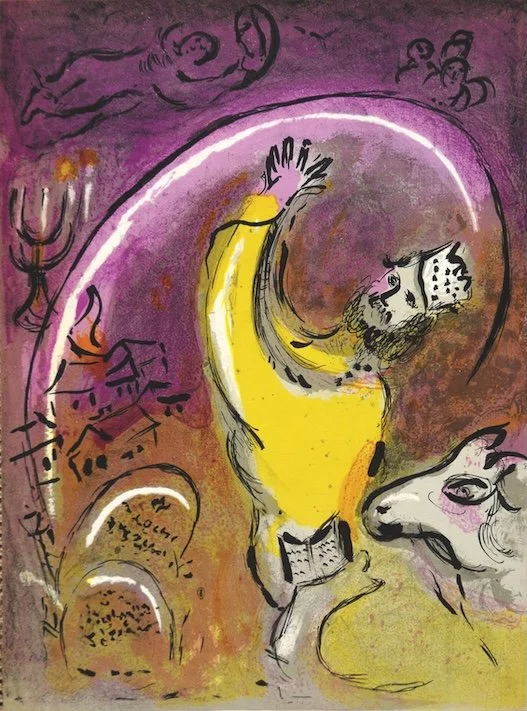
Lithograph, 1956
Suite: Bible Lithographs
Unsigned
Edition of 250
Paper size: 26 × 35.5cm
£1150 Framed
When Chagall met renowned printer, Fernand Mourlot in 1948 at his atelier in Paris, he realized that in lithography he had found the perfect graphic medium for his art. It rapidly became his preferred printing technique due primarily to the possibilities it offered with colour.
Following Tériade’s acquisition of the etched Bible Suite it was suggested that Chagall re-imagine a Bible Series in colour lithography. These lithographs, printed by the great French lithographers Mourlot Frères, were published in 1956. They were met with such critical praise that Chagall produced a further set in 1960.
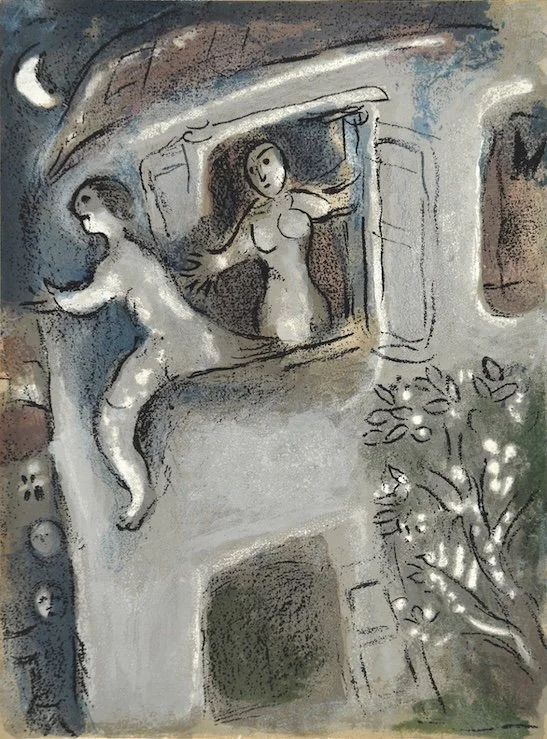
Etching and Drypoint
Unsigned
Edition of 960
Paper size: 80 × 40cm
£3000 Framed
Full set of 5 etching with drypoints to illustrate Marcel Arland's Maternité. Images include: La Honte, La Naissance, La Rixe, Couple au Lit and La Visite par la Fenêtre.
Etching, 1956
Suite: Bible Etchings
Signed in Plate
Edition of 295
Paper size: 23 × 32cm
£2000 Framed
This etching is from Chagall’s sublime Bible series. Almost 10 years in the making, and comprising over 100 etchings, it was the third of Chagall’s etching suites to be commissioned by the publisher Ambroise Vollard. Chagall’s Jewish identity had always informed his work; in this major suite, begun in 1930, it was to take centre stage.
Embarking on the project during a time of economic uncertainty, Chagall travelled to Palestine in 1931 for inspiration and worked on the plates throughout the 1930s, even as anti-Semitic violence and the rise of the Nazis threatened its existence. By January 1934, a major blow to the project came when Vollard suspended his financial support as he weathered the Depression, but Chagall continued unabated. The first 66 plates were completed by 1939, with the latter 39 already begun; but after Vollard’s untimely death and the advent of WWII, the project was postponed.
It would not be taken up again until 1952, when Chagall returned to the 39 unfinished plates. By 1956 the suite was complete, and a new publisher was found in Tériade. The final 105 etchings, characterised by an exquisite interweaving of lines hatched, scratched, and scored, are thought to be Chagall’s greatest and most personal work as a printmaker.
Etching and Aquatint, 1975-76
Suite: Celui qui Dit les Choses sans Rien Dire
Unsigned
Edition of 225
Paper size: 29.7 × 39cm
£2500 Framed
Delicate and intimate, Chagall’s etchings for this suite were made in 1976 when he was 89 years old at the very end of his life. They were published in an edition of 225 only, one of the artist’s last and most personal works.
Published by Maeght, Chagall illustrated the words of the French poet Louis Aragon for this suite of 25 etchings with aquatint. Aragon was one of the founding members of the Surrealist movement which swept through the art world in the early 1920s.
Aragon’s poetry was strange and diverse, often swaying between the lyrical and the overtly political. The title of Chagall’s series – ‘Those who speak without saying anything’ – highlights the satirical bent to Aragon’s poetry, but also the key surrealist concept of unconscious action: ‘speaking’ without ‘saying’.
Etching and Aquatint, 1975-76
Suite: Celui qui Dit les Choses sans Rien Dire
Unsigned
Edition of 225
Paper size: 29.7 × 39cm
£2500 Framed
Delicate and intimate, Chagall’s etchings for this suite were made in 1976 when he was 89 years old at the very end of his life. They were published in an edition of 225 only, one of the artist’s last and most personal works.
Published by Maeght, Chagall illustrated the words of the French poet Louis Aragon for this suite of 25 etchings with aquatint. Aragon was one of the founding members of the Surrealist movement which swept through the art world in the early 1920s.
Aragon’s poetry was strange and diverse, often swaying between the lyrical and the overtly political. The title of Chagall’s series – ‘Those who speak without saying anything’ – highlights the satirical bent to Aragon’s poetry, but also the key surrealist concept of unconscious action: ‘speaking’ without ‘saying’.
Lithograph, 1952/53
Suite: Visions de Paris
Unsigned
Paper size: 26.5 × 35.5cm
£850 Framed
Printed in France
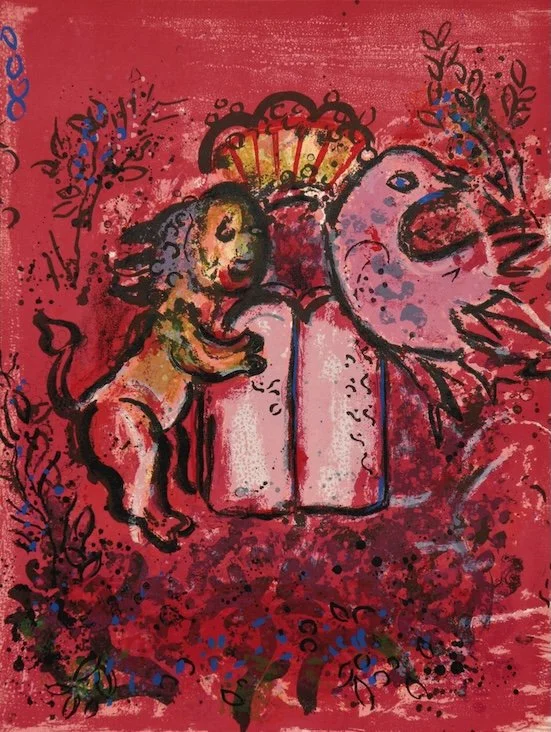
Lithograph, 1962
Suite: Twelve Tribes
Unsigned
Paper size: 82 × 82cm
£1950 Framed
A set of twelve original lithographs, 1962. Designed in 1962 by Marc Chagall as early studies for the Jerusalem windows. Printed in Paris by the renowned Atelier Mourlot. The designs of the windows are: Judah, Levi, Simeon, Reuben, Zebulun, Benjamin, Isaachar, Joseph, Dan, Gad, Asher and and Nephtali.
The Twelve Tribes lithographs after Chagall based on preliminary sketches for the Jerusalem stained-glass windows. In 1959 Chagall was commissioned to design twelve stained glass windows for the new synagogue of the Hadassah-Hebrew University Medical Centre, situated in the Judean hills west of Jerusalem. The number twelve is considered spiritual and sacred. These magnificent windows symbolise the twelve sons of Jacob from whom sprang the twelve tribes of Israel.
Lithograph, 1962
Unsigned
Paper size: 92 x 151cm
£4950 Framed
A set of twelve original lithographs, designed in 1962 as designs for the Jerusalem windows. Printed in Paris by the renowned Atelier Mourlot, some of which are in twenty colours. The designs of the windows are: Judah, Levi, Simeon, Reuben, Zebulun, Benjamin, Isaachar, Joseph, Dan, Gad, Asher and Nephtali. The Twelve Tribes lithographs after Chagall were based on preliminary sketches for the Jerusalem stained-glass windows. In 1959 Chagall was commissioned to design twelve stained glass windows for the new synagogue of the Hadassah-Hebrew University Medical Centrein Jerusalem. The number twelve is considered spiritual and sacred. These magnificent windows symbolise the twelve sons of Jacob from whom sprang the twelve tribes of Israel.
Keen that his designs be more widely disseminated, Chagall was closely involved with the production of the set of lithographs created by the world famous Mourlot. The publisher, James Parton, recalled how the artist stood beside the lithographer to watch the single sheets pass through the hand-fed stone press, one colour at a time, to catch every nuance of shading. He threw out the whole first set of gravure plates: the yellow, he felt, was off a shade.
Lithograph, 1960
Suite: Chagall Lithographie
Unsigned
Paper size: 24 x 32cm
£850 Framed
Printed by the renowned Atelier Mourlot, Paris and published by Andre Sauret
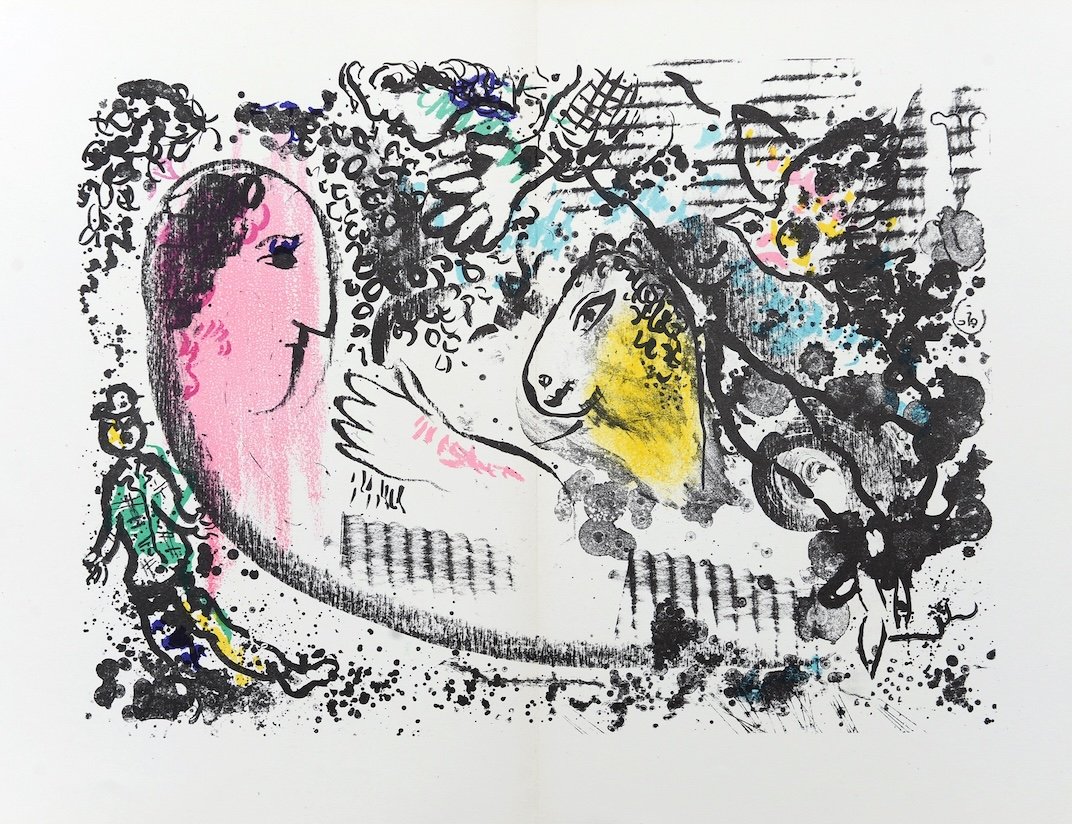
Lithograph, 1966
Unsigned
Edition of 1500
Paper size: 18.7 × 25.4cm
£850 Framed
Printed in 1966 by the renowned Atelier Mourlot. Published at Maeght Editeur for The Redfern Gallery.
Lithograph, 1960
Suite: Chagall Lithographie
Unsigned
Paper size: 24 x 32cm
£850 Framed
Printed by the renowned Atelier Mourlot, Paris and published by Andre Sauret.
Lithographic Poster, 1964
Unsigned
Paper size: 101 × 63.5cm
£2950 Framed
Original lithographic poster printed by Mourlot, Paris as a promotional poster for the Office for French Tourism. Illustrated in Sorlier p.96
In 1963 Chagall was commissioned by André Malraux to decorate the ceiling of the Paris Opera. He divided the vast space into several colour zones and wove together scenes and characters from the most beloved operas and ballets. The mural would honour the works of fourteen composers, from Mussorgsky to Mozart and Beethoven to Tchaikovsky . Chagall’s ceiling was unveiled on September 23, 1964 during the finale of a Mozart's Jupiter Symphony, the artist’s favourite composer. As the music swelled the great chandelier lit up to reveal the mural.
The opera house also asked Chagall to design a limited edition poster for the ceiling’s debut. The artist based the poster on a portion of the mural featuring Tchaikovsky’s Romeo and Juliet; the famous lovers hover in the air above Paris.