
Paragon Gallery is delighted to announce Literary Lions & Other Beasts, a major new exhibition by acclaimed British artist PJ Crook MBE RWA FRSA, opening with a Private View Evening on Friday 9th October and continuing until Saturday 7th November. The exhibition marks Crook's second solo show with the gallery and coincides with the town's annual Literature Festival, drawing together the worlds of narrative art and literature in a captivating new body of work.
Private View Evening - Friday 9th October 5.30 - 8pm
Exhibition ends Saturday 7th November
Following the success of her previous exhibition, Byron's Bear & Menagerie, Crook once again draws inspiration from the literary world, and the artist's fascination with the rich intersection of storytelling, imagination and human experience, this time through the enduring relationship between writers and animals. In this engaging new body of work, animals emerge as both companions and characters, occupying a space between historical reality and literary invention.
The exhibition explores the remarkable creatures that have inspired some of history's greatest writers. From Saint Jerome and the faithful lion he is said to have befriended, to Charles Dickens and his beloved raven, Grip, Crook uncovers fascinating stories that reveal the profound influence animals have had on creative lives.
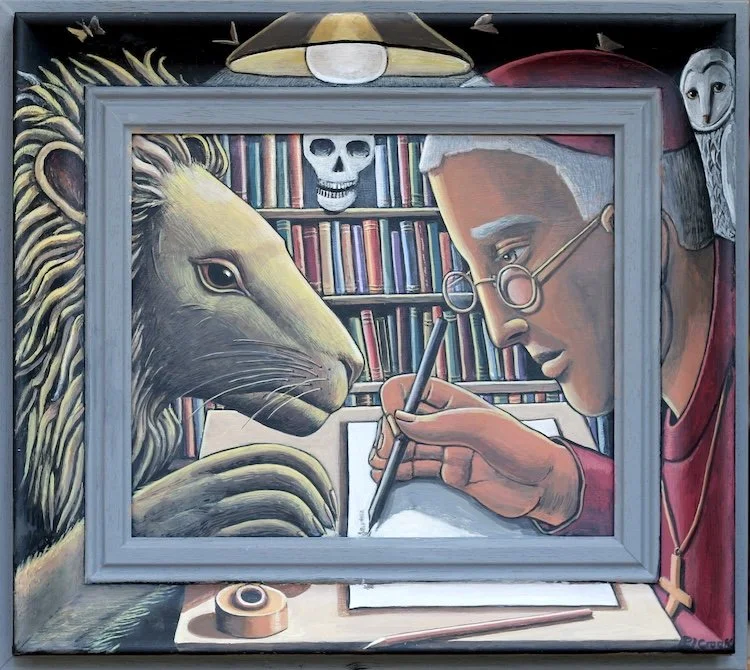
Saint Jerome and the Lion - Tinted Gesso on Wood
Known for her distinctive figurative style, wit and keen observation of human behaviour, PJ Crook brings these literary beasts vividly to life. Her paintings weave together history, myth, narrative and humour, inviting viewers to rediscover familiar stories through fresh eyes. Whether depicting real animal companions or creatures born entirely from imagination, Crook's works celebrate the powerful role animals play in literature and in our collective cultural memory.
Literary Lions & Other Beasts will be on view at Paragon Gallery throughout October and into November, and offers visitors a rare opportunity to experience a new collection from one of Britain's most celebrated contemporary painters. Rich in narrative, character and curiosity, the exhibition promises an enchanting journey through the worlds of art, literature and the animal kingdom.
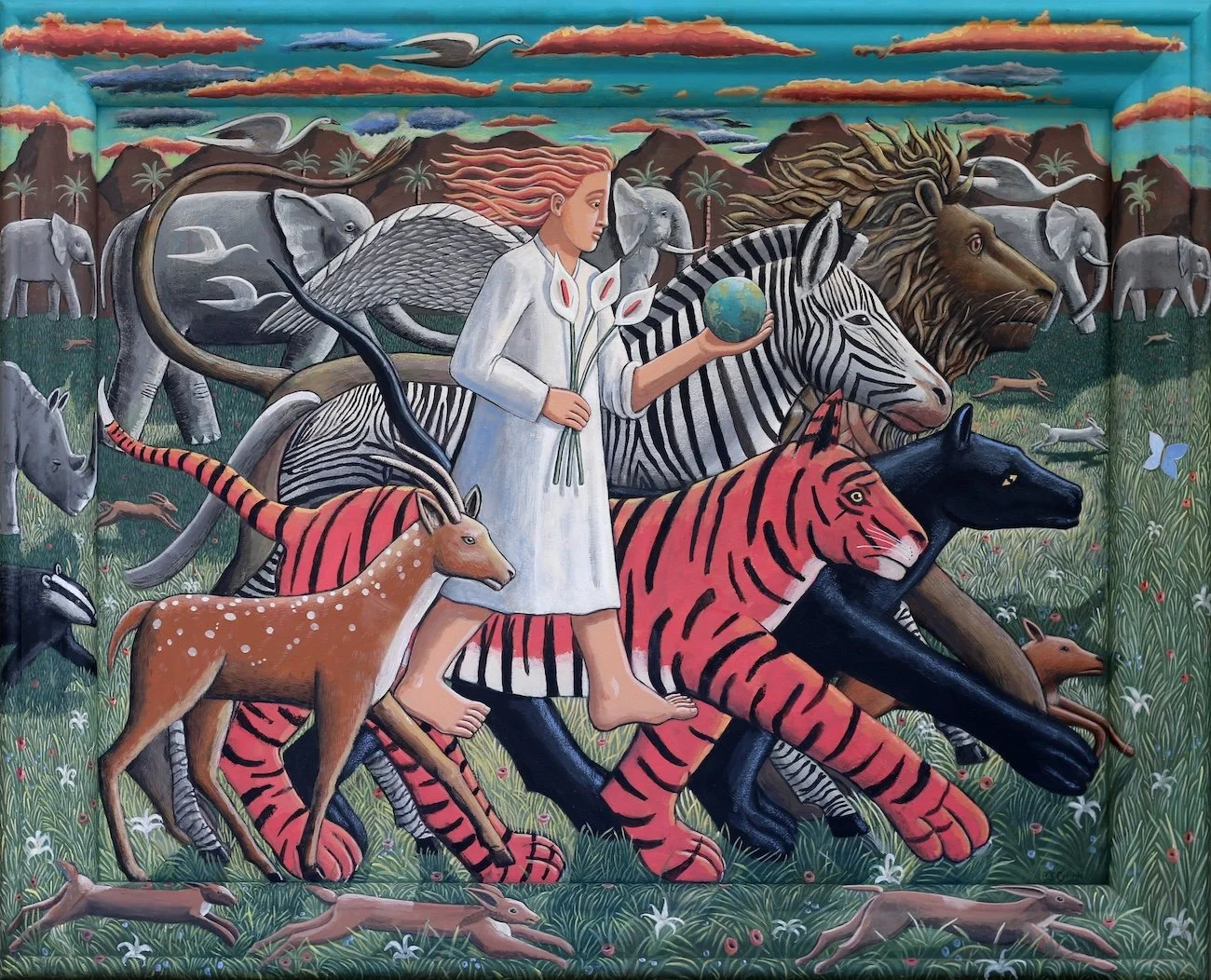
The Angel, The Globe and The Animals - Tinted Gesso on Wood
Artist’s Note:
“Because I so enjoyed my last exhibition, Byron’s Bear & Menagerie, here at the Paragon Gallery, I wanted to continue in a similar but different vein. So as this exhibition is once again tying up with the Literature Festival, I have opted for Literary Lions & Other Beasts. Sometimes the subject matter of the paintings is the actual animal companion of the writer, whilst others are the animals they are imagining and writing into their story.
Throughout history we find writers such as Saint Jerome sharing his library with the faithful Lion who he rescued by removing a thorn from his paw; through to Dickens who kept a raven called Grip whom he loved; he even taught it to speak in Cockney slang. When it died, he personally learned how to be a taxidermist as he couldn’t bear to be parted. In fact, he had three ravens one after another and they were all called Grip, also a canary, an eagle and cats. What is even more fascinating is another writer, in the USA, was so intrigued with the story that later when the stuffed Grip came up for auction, he purchased it and when you know it was Edgar Allen Poe, who wrote his famous poem The Raven, you realise what a profound effect it had on his writing.
Leo Tolstoy wrote one of the most moving and sorrowful stories about a Piebald horse called Strider, and Shakespeare has the most famous stage direction ever written "Exit, pursued by a Bear…” Then in 19th century fairy tales, Southey wrote a version of Goldilocks and the three bears where the three bears were all male but mine stay with the more traditional Mother, Father & baby bear. The Goldilocks Principal of “just the right amount”, neither too hot nor too cold, has entered the language of psychology, economics, engineering and biology.
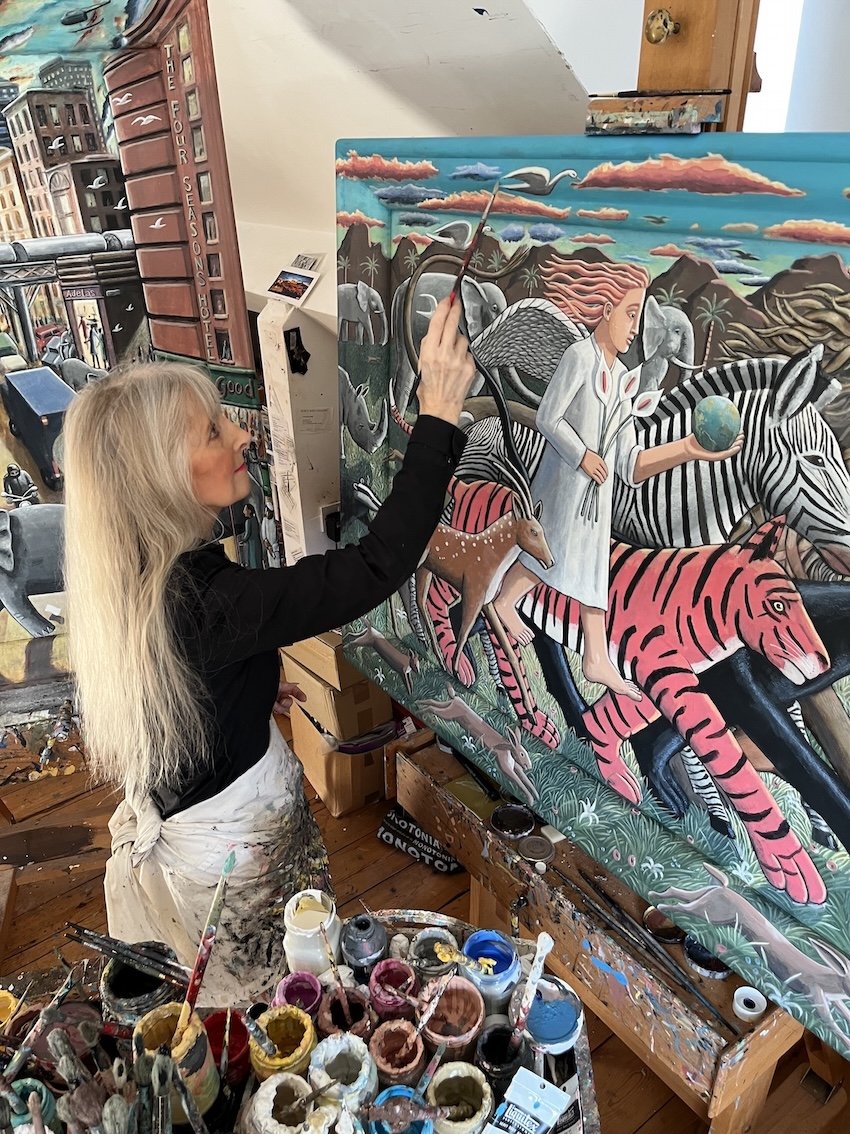
PJ Crook in her studio working on The Angel, The Globe and The Animals
As a child I can remember my father reading to me from The Tootinemeh or Tales of a Parrot, translated from the Persian language, a famous collection of stories told by the parrot to his mistress to delay or postpone her what would be unfaithful encounters with a lover.
A parrot is also the protagonist in Julian Barnes’ Flaubert’s Parrot where he, rather like Dickens’ Raven, ends up immortalised by a taxidermist. Flaubert also thought of himself as a Bear whilst his sister was a Rat. Bears are often symbols either of affection or as an aggressor - Russia is often depicted as the Bear.
Judith Kerr wrote the moving Hitler Stole Pink Rabbit but later the most wonderful The Tiger Who Came to Tea, who not only drunk from the spout of the teapot but also emptied all the taps with a voracious appetite and thirst. The family in the story would now all have been older or retired so he’s turned up at a Christmas tea dance for senior citizens as well as appearing in the doorway of a family meal in A Tiger Who Came to See.
Whilst working in my studio I often hear fascinating stories on the radio 4 news bulletin, where a few years ago two runaway Tamworth pigs captured the hearts of the nation in their bid not to become bacon.
I likewise became very engaged by the travels of a herd of Indian elephants who left their reserve to find more fodder, raiding plantations and eventually arriving in a town at night and more recently, the World Service African elephants in Zimbabwe moving into residential areas, again looking for food. In my mind’s eye these conjured up a bizarrely beautiful image that I've tried to convey in Elephants in The City.
Robert Louis Stevenson’s famous Travels with a Donkey has always had an alluring appeal. It was particularly after his parents disapproved of and forbade a long relationship he had with a married woman that he set out to ease his pain with a trek in the mountainous regions of France. The female donkey was no bigger than a Newfoundland dog and often found it hard to keep pace with his long-legged owner, whilst carrying such a burdensome load. To start with Stevenson was very sympathetic and resisted hitting the poor beast with a switch but as his frustration grew, he became more and more impatient, eventually selling the poor animal and completing the journey by train.
Several years ago, a friend sent us a copy of Jan Martel’s The Life of Pi. The story is about Pi being shipwrecked and sharing a lifeboat with a zebra, a hyena, and orangutang and a large Bengal tiger whose name was Richard Parker. And since I’m married to a Richard Parker, I felt a great attachment to him. Gradually during the adventure, the other animals are eaten by the tiger so only Pi and Richard Parker remain. It is a thrilling read and eventually they reach land and go off in different directions. Barac Obama wrote to Jan Martel to say that after reading it, it convinced him that there was a god.
One of my favourite books is George Orwell’s Animal Farm, this wonderful analogy of how Stalin’s communism took over Russia and much of the world was told in the form of a simple farmyard tale, where the animals were radicalised by the pigs into rebellion and takeover. Their manifesto originally said 2 Legs Bad, 4 Legs Good but in the last scene the pigs have taken upon themselves all the characteristics of human beings, wearing their clothes, living in the farmhouse, drinking their whiskey, gambling and cheating.
The Elephant Boy is a Kipling story of the bonding between the largest of animals and one of the smaller humans, just a boy conveying that trust and patience can achieve more than force and aggression.
Speaking of Mr Lear reflects my admiration for the work of Edward Lear, both his writings and his paintings. Born the penultimate of 21 children he was mainly brought up by his oldest sister. He was a rather sad man who suffered from epilepsy and much unhappiness about his appearance, yet he possessed an extraordinary talent and wit for writing nonsense verse and creating beautiful paintings, often of parrots from the Earl of Derby’s Menagerie where he was an artist in residence. The irony is that he has brought great joy and happiness to children and adults through the generations which I hope would have made him happy.
The Sport of Queens by Dick Francis. I love the thought of a jockey turned writer as Dick Francis did, employing all his experience and incorporating it into his well plotted tales of ’snobbery with violence’.
The Angel, The Globe & The Animals is a story or theme I often weave into my paintings, paying homage to our planet that is in danger of overheating and burdened with the things we discard or plunder for its resources that gradually become fewer. I sometimes feel we need a little more guidance to travel in the right direction.
As we neared the end of the Millennium, I liked to think we had learned a lot by the mistakes we humans had made during the past thousand years, though we had also achieved unbelievable advances in medicine, science, technology and hoped for a more harmonious future. Thus, I gathered together those papers printed on the Last day of the Millennium, on the eve of a new beginning.
My son Nathan is a Tiger child being born in the Chinese year of the Tiger. So, tigers have always felt rather important to me and I relate strongly to the spiritual work of William Blake. The words of his poem Tiger Tiger are so powerful when he writes “...what dread hands and what dread feet caused thy mighty heart to beat…” conjuring up a magnificent beast of great strength and yet when you look at the illustration he created in his exquisite little book Songs of Innocence and Experience the tiger looks quite tiny and amiable and almost feels like a contradiction.
Leaping for Joy. I often feel that I am extraordinarily fortunate to have spent my life creatively when so many people have to do jobs that they don't particularly enjoy; I count my blessings every day and sometimes have to pinch myself."